
Blogs
Why I Refused to Buy a Fast Grinder?
Jun
I still remember the day my supplier first showed me his new machine. It was loud, shiny, and fast — “madam, kuch minutes mein ho jaayega,” he said, beaming, clearly expecting me to be thrilled. And honestly, for a moment, I was. I almost said yes on the spot. It would have saved me hours every single day, hours I could have spent with my grandchildren instead of standing in that processing room.
But something held me back. I picked up a handful of the powder it had just made. It was almost hot — and the smell was thin, nowhere close to the deep, earthy aroma I remembered from my mother’s kitchen, where turmeric was always ground slowly on a stone chakki while she hummed something under her breath.
That bothered me more than I expected it to. I couldn’t stop thinking about it that night. So I started asking around, reading whatever I could find, and talking to people who understood food science far better than I did. What I learned changed how I thought about every spice we make at Shubhavni — and honestly, it changed how I thought about what I was responsible for as someone who sells food to other families.
High-speed steel grinders can spin at over 3,000 RPM. All that speed creates friction, and friction creates heat — sometimes touching 100°C or more. Turmeric’s curcumin, the compound responsible for both its colour and most of its anti-inflammatory benefits, doesn’t survive that kind of heat well. Neither do the volatile aromatic oils that give good turmeric its smell and its potency. You end up with a powder that looks perfectly fine on the shelf, but has quietly lost much of what made it valuable in the first place — the very thing a family is paying for without even knowing it’s missing.
That thought stayed with me for days. When someone buys our turmeric for a child’s warm milk at night, or to ease a joint pain their mother has lived with for years, they are trusting that what’s inside that pack is actually doing something for them. If I cut that corner just to grind faster and earn a little more, I would be selling them a beautiful golden colour and nothing else — an empty promise in a pretty pack. I couldn’t live with that, and I certainly couldn’t put my name on the box and call it Shubhavni.
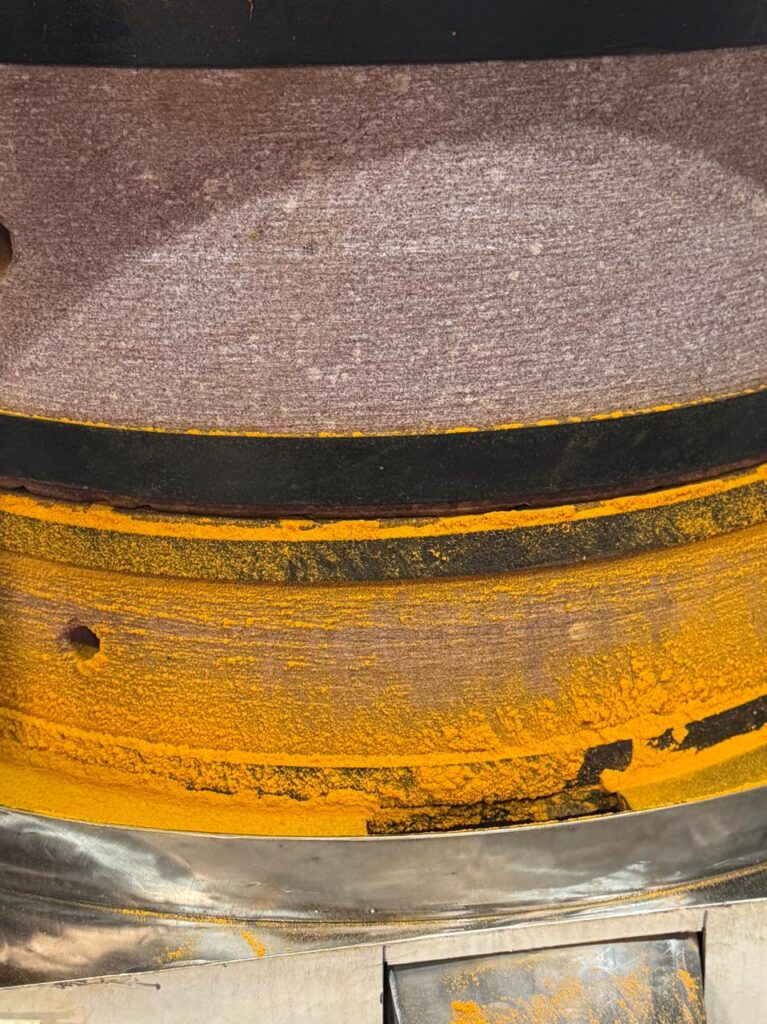
So I made a decision that probably didn’t make much business sense on paper: we would grind at just 96 RPM, the old stone mill speed, keeping temperatures near room temperature the way it was always meant to be done. It takes far longer. Our output each day is a fraction of what that fast machine could have given me. But the turmeric that comes out is still only warm to the touch, never hot — the curcumin stays where it belongs, the aroma stays alive, and when you open a fresh pack, the smell hits you immediately, the same way it did when I was a little girl in my mother’s kitchen.
I won’t pretend this is the easy path. Slow grinding means smaller batches, more patience, and a higher cost that I’ve tried very hard to absorb rather than pass entirely onto our customers. But every single time I open a fresh pack and that first burst of real turmeric reaches me, I know we made the right choice — not just for how it tastes, but for what we are actually placing into the food that families like yours will eat.
Some things in life are worth doing the slow way. I believe this is one of them.
— Shubha
